


[2023] Get Top-Rated MuleSoft MCD-Level-1 Exam Dumps Now
Passing Key To Getting MCD-Level-1 Certified Exam Engine PDF
How to study the MuleSoft Certified Developer - Level 1 Exam
Preparation of certification exams could be covered with two resource types. The first one are the study guides, reference books and study forums that are elaborated and appropriate for building information from ground up. Apart from them video tutorials and lectures are a good option to ease the pain of through study and are relatively make the study process more interesting nonetheless these demand time and concentration from the learner. Smart candidates who wish to create a solid foundation altogether examination topics and connected technologies typically mix video lectures with study guides to reap the advantages of each but practice exams or practice exam engines is one important study tool which goes typically unnoted by most candidates. Practice exams are designed with our experts to make exam prospects test their knowledge on skills attained in course, as well as prospects become comfortable and familiar with the real exam environment. Statistics have indicated exam anxiety plays much bigger role of students failure in exam than the fear of the unknown. Pass4cram expert team recommends preparing some notes on these topics along with it don't forget to practice MuleSoft mcd-level-1 exam dumps which had been written by our expert team, each of these can assist you loads to clear this exam with excellent marks.
NEW QUESTION # 73
An app team is developing a mobile banking app. It took them two months to create their own APIs to access transaction information from a central database. The app team later found out that another team had already built an API that accesses the transaction information they need.
According to MuleSoft, what organization structure could have saved the app team two months of development time?
- A. Central API Review Board
- B. Center of Excellence
- C. MuleSoft Support Center
- D. Center for Enablement
Answer: D
NEW QUESTION # 74
Refer to the exhibits.
What payload and variable are logged at the end of the main flow?
- A. [[5, 10, 15, 20], 5]
- B. [[5, 10, 15, 20], 1]
- C. [Req5Req10,Req15Req20, 5]
- D. [[Req5, Req10, Req15, Req20], 5]
Answer: A
Explanation:
Correct answer is [[5, 10, 15, 20], 5]
Key thing to note here is that any changes made to payload in for each loop are not available outside for each scope where as variable value updated in for each loop is visible out side for each loop too.
NEW QUESTION # 75
How does APIkit determine the number of flows to generate from a RAML specification?
- A. Creates a separate flow for each resource
- B. Creates a separate flow for each response status code
- C. Creates a separate flow for each resource that contains child resources
- D. Creates a separate flow for each HTTP method
Answer: D
Explanation:
APIKIt Creates a separate flow for each HTTP method
NEW QUESTION # 76
Refer to the exhibits.
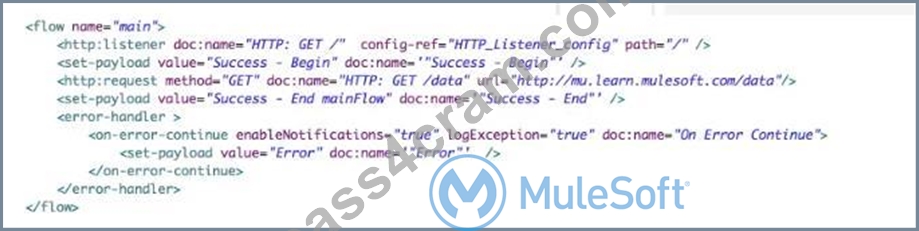
A web client submits a request to the HTTP Listener and the HTTP Request throws an error.
What payload and status code are returned to the web client?
Refer to the exhibits. A web client submits a request to the HTTP Listener and the HTTP Request throws an error.
What payload and status code are returned to the web client?
- A. Response body: "Success - Begin* Default response status code: 200
- B. Response body: "Success - End" Default response status code: 200
- C. Response body: "Error" Default response status code: 200
- D. Error response body: error, description Default error response status code: 500
Answer: C
NEW QUESTION # 77
Refer to the exhibit.
What is the correct DataWeave expression for the Set Payload transformer to call the createCustomerObject flow with values for the first and last names of a new customer?
- A. lookupf "createCustomerObject", { first: "Alice", last: "Green" > )
- B. createCustomerObject( { first: "Alice", last: "Green" > )
- C. createCustomerObject( "Alice", "Green")
- D. lookupC createCustomerObJect( "Alice", "Green- ) )
Answer: A
NEW QUESTION # 78
Refer to the exhibits.
The two Mule configuration files belong to the same Mule project. Each HTTP Listener is configured with the same host string and the port number, path, and operation values are shown in the display names.
What is the minimum number of global elements that must be defined to support all these HTTP Listeners?
- A. 0
- B. 1
- C. 2
- D. 3
Answer: D
NEW QUESTION # 79
Refer to the exhibit.
What is the response to a web client request to http://localhost:8081?
- A. null
- B. Validation Error
- C. After
- D. before
Answer: C
NEW QUESTION # 80
Refer to the exhibit.


What payload is returned from a request to http//localhost.8081/
Refer
to the exhibits, what payload is returned from a request to http://localhost;8081/?
- A. 0
- B. 1
- C. 2
- D. 3
Answer: A
NEW QUESTION # 81
What statement is a part of MuleSoft's description of an application network?
- A. Leverages Central IT to deliver complete point-to-point solutions with master data management
- B. Creates and manages a collection of JMS messaging services and infrastructure
- C. Creates reusable APIs and assets designed to be consumed by other business units
- D. Creates and manages high availability and fault tolerant services and infrastructure
Answer: C
Explanation:
Creates reusable APIs and assets designed to be consumed by other business units
NEW QUESTION # 82
A Mule project contains a DataWeave module like WebStore.dwl that defines a function named loginUser. The module file is located in the project's src/main/resources/libs/etl folder.
What is correct DataWeave code to import all of the WebStore.dwl file's functions and then call the loginUser function for the login
"[email protected]"?
- A. 1. 1. import * from libs::etl
2. 2. ---
3. 3. WebStore::loginUser("[email protected]") - B. 1. 1. import * from libs::etl::WebStore
2. 2. ---
3. 3. loginUser("[email protected]") - C. 1. 1. import libs.etl.WebStore
2. 2. ---
3. 3. loginUser("[email protected]") - D. 1. 1. import libs.etl
2. 2. ---
3. 3. WebStore.loginUser("[email protected]")
Answer: B
Explanation:
* To use custom modules, you need to import the module or functions you want to use by adding the import directive to the head of your DataWeave script, for example:
1) Does not identify any functions to import from the String module:
import dw::core::Strings
2) To identify a specific function to import from the String module:
import camelize, capitalize from dw::core::Strings
3) To import all functions from the String module:
import * from dw::core::Strings
The way you import a module impacts the way you need to call its functions from a DataWeave script. If the directive does not list specific functions to import or use * from to import all functions from a function module, you need to specify the module when you call the function from your script.
* In given scenario, it's mentioned to import all of the WebStore.dwl
So correct answer is:
NEW QUESTION # 83
Refer to the exhibits.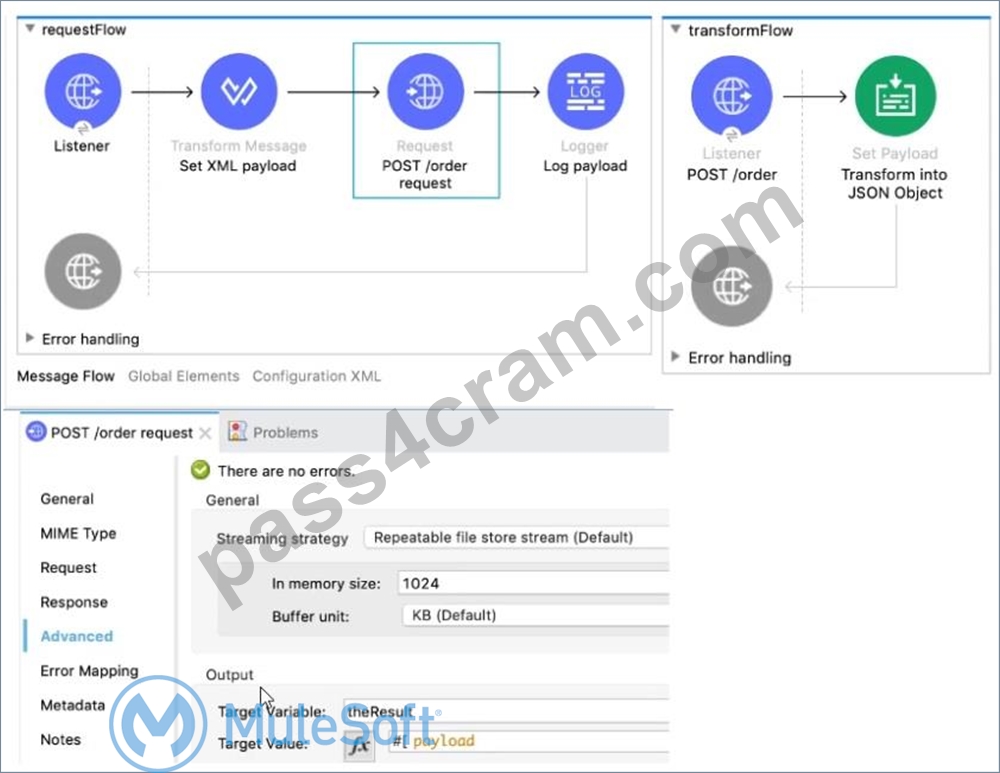
In the requestFlow an HTTP Request operation is configured to send an HTTP request with an XML payload.
The request is sent to the HTTP Listener in the transform Flow.
That flow transforms the incoming payload into JSON format and returns the response to the HTTP request.
The response of the request is stored in a target variable named the Result.
What is the payload at the Logger component after the HTTP Request?
- A. null
- B. The returned JSON response
- C. A non-empty Java object
- D. The original XML payload
Answer: D
NEW QUESTION # 84
A mule project contains MySQL database dependency . The project is exported from Anypoint Studio so that it can be deployed to Cloudhub. What export options needs to be selected to create the smallest deployable archive that will successfully deploy to Cloudhub?
- A. Select only below option 1) Attach project sources
- B. Select only below option 2) Include project module and dependencies
- C. No need to select any of the below options 1) Attach project sources 2) Include project module and dependencies
- D. Select both the options 1) Attach project sources 2) Include project module and dependencies
Answer: B
Explanation:
You can choose Attach Project Sources to include metadata that Studio requires to reimport the deployable file as an open Mule project into your workspace. You must keep the Attach Project Sources option selected to be able to import the packaged JAR file back into a Studio workspace. But requirement here is to create smallest deployable archive that will successfully deploy to Cloudhub. Hence we can ignore this option.
We need to select Include project module and dependencies
As actual modules and external dependencies required to run the Mule application in a Mule runtime engine Hence correct answer is Select only below option 2) Include project module and dependencies MuleSoft Doc Ref : https://docs.mulesoft.com/studio/7.5/import-export-packages#exporting-a-studio-project-to-a-deployable-mule-application
NEW QUESTION # 85
Does a root element required when creating a XML response using Dataweave?
- A. None of these
- B. Always required
- C. Not required
- D. Depends on requirement
Answer: B
Explanation:
Root element is always required while creating XML response in DataWeave transformation
NEW QUESTION # 86
Refer to the exhibits.
What is the response when a client submits a request to http://localhost:8081?
- A. After
- B. null
- C. Validation error
- D. Before
Answer: C
Explanation:
----------------------------------------------------------------------------------------------------------------------------------- Here's specifically what is happening here:
1) Payload is successfully set to "Before"
2) Is null validation is used which will pass the message only if payload is null. In this case as payload is not null, it creates an Error Object. Flow execution stops
#[error.description] = "Validation error"
3) Because no error handler is defined, the Mule default error handler handles the error
4) "Validation error" is the error message returned to the requestor in the body of the HTTP request with HTTP Status Code: 500 Reference diagram:
NEW QUESTION # 87
Refer to the exhibits.
The main flow contains a Flow Reference to the child flow.
A web client sends a GET request to the main flow's HTTP Listener that includes a make query parameter.
What values are accessible in the child flow?
- A. payload
make query param - B. payload
make query param model var - C. payload
model var - D. payload
Answer: B
NEW QUESTION # 88
Refer to the exhibit.
How many private flows does APIKIT generate from the RAML specification?
- A. 0
- B. 1
- C. 2
- D. 3
Answer: A
NEW QUESTION # 89
Refer to the exhibits. In the color flow , both the variable named color and payload are set to "red".
An HTTP POST request is then sent to the decideColor flow's HTTP Listener.
What is the payload value at the Logger component after the HTTP request completes?

- A. white
- B. red
- C. Error message
- D. blue
Answer: D
Explanation:
Correct answer is white.
Key thing to note here is that variables are not available to the called flow when it is invoked using HTTP request.
So the flow goes like below
1) Color variable is set to red
2) Payload is set to red
3) Child flow is called using HTTP request which means variables are not available in called flow (They would have been if flow reference activity would have been used)
4) Hence set payload activity will set payload to white as color variable is null
5) Payload returned in main flow is white.
6) So finally output of logger is white
NEW QUESTION # 90
Refer to the exhibits.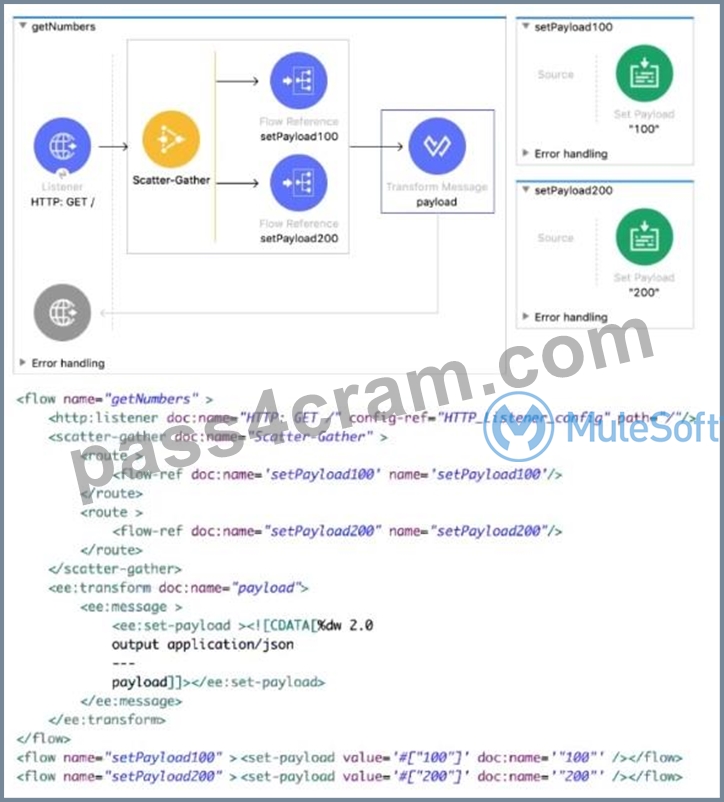
The input array of strings is processed by the batch job that processes, fitters, and aggregates the values.
What is the last message logged by the Logger component after the batch job completes processing?
A)
B)
C)
D)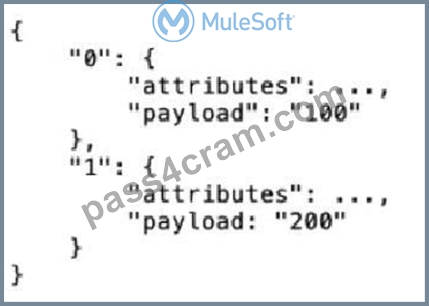
- A. Option D
- B. Option B
- C. Option A
- D. Option C
Answer: D
NEW QUESTION # 91
Why would a Mule application use the ${http.port} property placeholder for its HTTP Listener port when it is deployed to CloudHub?
- A. Allows clients to VPN directly to the application at the Mule application's configured HTTP port
- B. Allows CloudHub to automatically register the application with API Manager
- C. Allows CloudHub to automatically change the HTTP port to allow external clients to connect to the HTTP Listener
- D. Allows MuleSoft Support to troubleshoot the application by connecting directly to the HTTP Listener
Answer: C
Explanation:
This helps CloudHub to dynamically allocates a port at deployment time.
MuleSoft Doc Ref : https://docs.mulesoft.com/mule-runtime/4.3/deploy-to-cloudhub#prerequisites
NEW QUESTION # 92
Refer to the exhibit.
The main flow contains a Flow Reference for the child flow.
What values are accessible in the child flow after a web client submits a request to http://localhost:8Q81/order? color=red?
- A. payload
quantity var - B. payload
quantity var color query param - C. payload
- D. payload
color query param
Answer: B
Explanation:
Correct answer is
payload
quantity var
color query param
NEW QUESTION # 93
Refer to the exhibit.
What is the output payload in the On Complete phase
- A. The original payload: [1,2,31
- B. summary statistics with NO record data
- C. The records processed by the last batch step: [StepTwol, StepTwo2, StepTwo3]
- D. The records processed by all batch steps: [StepTwostepOnel, stepTwostepOne2, StepTwoStepOne3]
Answer: B
NEW QUESTION # 94
A Utility.dwl file is located in a Mule project at src/main/resources/modules. The Utility.dwl hie defines a function named pascalize that reformats strings to pascal case.
What is the correct DataWeave to call the pascalize function in a Transform Message component?
A)
B)
C)
D)
- A. Option D
- B. Option B
- C. Option C
- D. Option A
Answer: B
NEW QUESTION # 95
A Mule application contains an ActiveMQ JMS dependency. The Mule application was developed in Anypoint Studio and runs successfully in Anypoint Studio.
The Mule application must now be exported from Anypoint Studio and shared with another developer.
What export options create the smallest JAR file that can be imported into the other developer's Anypoint Studio and run successfully?
- A. Option C
- B. Option D
- C. Option B
- D. Option A
Answer: B
NEW QUESTION # 96
Refer to the exhibits.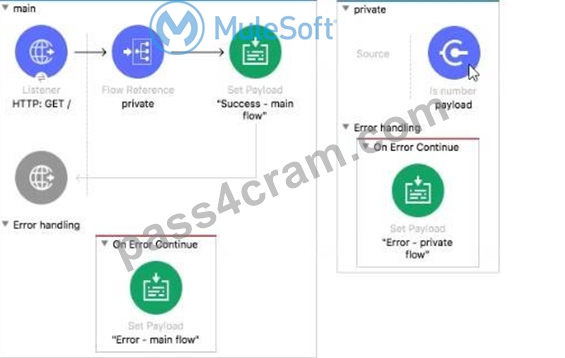

The Validation component in the private flow throws an error. What response message is returned to a client request to the main flow's HTTP Listener?
- A. Success - main flow
- B. Validation Error
- C. Error - private flow
- D. Error - main flow
Answer: A
NEW QUESTION # 97
A Utility.dwl file is located in a Mule project at src/main/resources/modules. The Utility.dwl hie defines a function named pascalize that reformats strings to pascal case.
What is the correct DataWeave to call the pascalize function in a Transform Message component?
A)
B)
C)
D)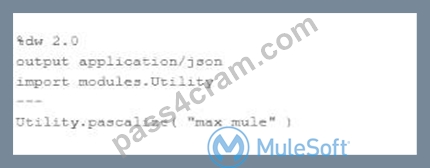
- A. Option D
- B. Option B
- C. Option C
- D. Option A
Answer: B
NEW QUESTION # 98
......
MCD-Level-1 exam questions for practice in 2023 Updated 226 Questions: https://tesking.pass4cram.com/MCD-Level-1-dumps-torrent.html