


[Apr 03, 2026] 400-007 PDF Dumps is essential on your 400-007 Exam Questions Certain Success!
400-007 PDF Questions - Perfect Prospect To Go With 400-007 Practice Exam
The CCDE v3.0 Written exam is a challenging test that covers a wide range of topics related to network design. Some of the key topics covered in the exam include network design methodologies, network security, routing protocols, network virtualization, and network management. To pass the exam, candidates must demonstrate a thorough understanding of these topics and be able to apply their knowledge to real-world scenarios.
NEW QUESTION # 148
Organizations that embrace Zero Trust initiatives ranging from business policies to technology infrastructure can reap business and security benefits. Which two domains should be covered under Zero Trust initiatives?
(Choose two)
- A. work domain
- B. workplace
- C. workgroup
- D. workload
- E. workspace
Answer: B,D
NEW QUESTION # 149 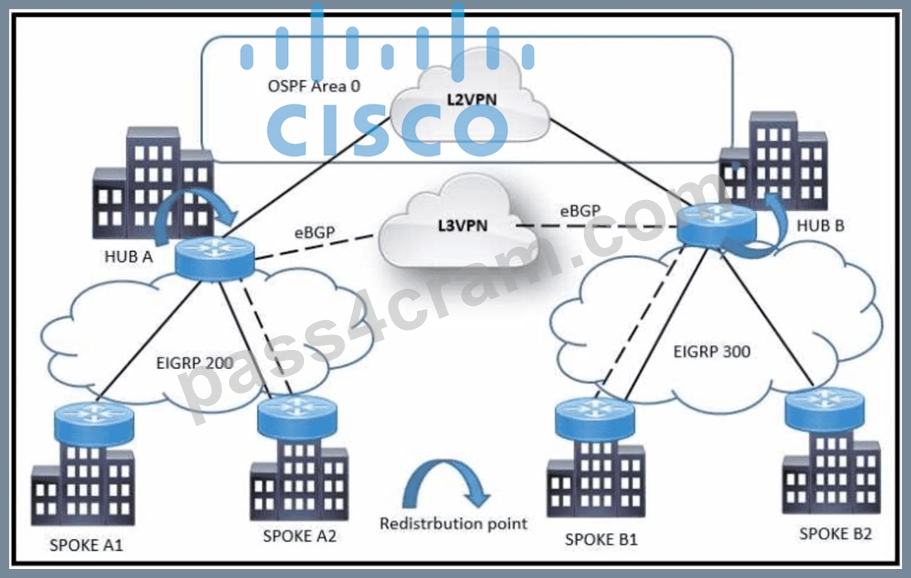
Refer to the exhibit: A customer is migrating from a TDM-based Layer 2 VPN (L2VPN) to an MPLS Layer 3 VPN (L3VPN) in phases. The backbone OSPF connection between HUB A and HUB B will be replaced by eBGP. During the migration, some spokes (A2 and B1) are already moved to the L3VPN. The goal is to avoid routing loops during this hybrid transition.
Which design choice helps prevent routing loops during the backbone link migration?
- A. OSPF backbone area advertises summarized routes to hub
- B. Enable route filtering on OSPF backbone routers for spoke traffic
- C. Redistribute EIGRP 200 and 300 with low cost into BGP
- D. Advertise low AD value for transit traffic on hub sites
Answer: B
Explanation:
# Comprehensive Explanation:
* A: In hybrid WAN designs where routing domains are gradually migrating from OSPF to BGP, particularly with overlapping domains or redistribution points, loops can occur if the same routes are seen via multiple protocols (e.g., BGP and OSPF). Implementing route filtering on the OSPF backbone prevents it from learning and advertising spoke routes that it also receives via BGP-eliminating the loop scenario.
* B: Advertising a low administrative distance (AD) for transit traffic does not prevent loops and may worsen convergence or cause routing inconsistency.
* C: Summarizing OSPF routes may reduce the routing table size, but it does not solve the loop issue caused by dual protocol redistribution unless filtering is applied.
* D: Redistributing EIGRP routes into BGP with a low cost might cause preference toward one path but does not address the loop risk between the hybrid segments (OSPF and BGP).
This is a classic use case for route filtering in dual-protocol or dual-backbone migrations, where ensuring consistent path selection and loop prevention is essential.
NEW QUESTION # 150
Which two characteristics apply to firewall transparent mode operations in a firewall solution design?
(Choose two.)
- A. Changes in the existing IP addressing and subnets are required
- B. Multicast traffic can traverse the firewall.
- C. OSPF adjacencies can be established through the firewall
- D. The firewall acts like a router hop in the network.
- E. The firewall can participate actively on spanning tree.
Answer: B,C
NEW QUESTION # 151
Management is often overlooked during the design of a network because it is considered an operational issue rather than a design issue. A hierachical disrupted arrangment can be used whereby disrupted NMSs send data to sophisticated centralized NMSs using a manager-of- managers architecture. What is an advantage of a disrupted management system?
- A. more sophisticated and globally controlled security mechanism
- B. simplified tracking of management devices and assets
- C. easier to contain the amount of data that is collectedand stored
- D. reduced amount of network management data flows accross the network
Answer: D
Explanation:
In a distributed management system, local or regional Network Management Systems (NMSs) collect and process data from their respective network segments. They then send summarized or aggregated information to a centralized, more sophisticated NMS. This hierarchy:
- Reduces the volume of raw management data that needs to be transmitted across the entire network, lowering bandwidth consumption and improving scalability.
- Allows localized management and quicker responses to issues within segments.
- Enables the centralized NMS to focus on high-level analysis and decision-making without being overwhelmed by raw data.
NEW QUESTION # 152
Refer to the exhibit.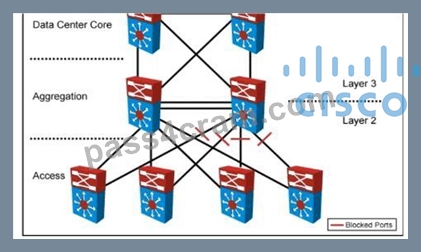
Your company designed a network to allow server VLANs to span all access switches in a data center. In the design, Layer 3 VLAN interfaces and HSRP are configured on the aggregation switches. Which two features improve STP stability within the network design? (Choose two.)
- A. access switch pairs explicitly determined to be root and backup root bridges
- B. BPDU guard on the aggregation switch downlinks toward access switches
- C. BPDU guard on access ports
- D. edge port on access ports
- E. root guard on access ports
- F. root guard on the aggregation switch downlinks toward access switches
Answer: C,F
Explanation:
* A (BPDU Guard on access ports): Prevents accidental connection of switches or bridging devices on access ports, which could cause unexpected topology changes or loops.
* C (Root Guard on aggregation switch downlinks): Ensures access switches cannot send superior BPDUs to challenge aggregation switch root status, maintaining predictable STP root placement.
Why other options are incorrect:
* B: Aggregation downlinks are not normally configured with BPDU Guard (since they expect BPDUs from access switches).
* D: Root guard on access ports is unnecessary as those ports should not participate in STP.
* E: Edge port (Rapid STP concept) is good for faster convergence but doesn't address stability.
* F: STP root and backup root election is important but not a specific STP feature - this is a design decision, not a stability feature.
NEW QUESTION # 153
Refer to the exhibit.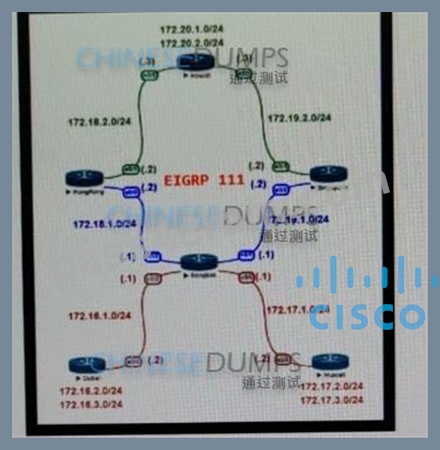
For Company XYZ Bangkok is using ECMP to reach the 172 20 2 0/24 network The company wants a design that would allow them to forward traffic from 172 16 2 0/24 toward 172 20 2 0/24 via the Singapore router as the preferred route The rest of the traffic should continue to use ECMP Which technology fulfills this design requirement?
- A. LFA
- B. policy-based routing
- C. route summarization
- D. unequal-cost load balancing using variance
Answer: B
NEW QUESTION # 154
Which technology supports antispoofing and does not have any impact on encryption performance regardless of packet size?
- A. IPsec
- B. DHCP snooping with DAI
- C. MACsec
- D. IP source guard
Answer: C
NEW QUESTION # 155
[Security, Automation, and Policy Integration in Design] A banking customer using mobile token authentication suffers unauthorized access through phishing. Which policy change helps prevent this in the future?
- A. Monitor all API interfacing to the storage platform for suspicious activity
- B. Monitor connections to unknown cloud instances using SSL decryption
- C. Monitor the privileges for users making firewall configuration changes
- D. Monitor any access from the outside except for expected operational areas
Answer: B
Explanation:
# Explanation:
* A: Phishing attacks often spoof SSL/TLS sessions or redirect traffic to rogue endpoints. Monitoring connections to unknown cloud instances-especially with SSL decryption-can detect traffic to phishing sites or unauthorized resources.
Other options:
* B: Monitoring APIs helps but doesn't directly address phishing-based redirection.
* C: Blanket outside access restrictions are impractical and not effective against token hijacking.
* D: Firewall config changes are administrative-level concerns, unrelated to app-level token misuse.
NEW QUESTION # 156
Drag and drop the multicast protocols from the left onto the current design situation on the right.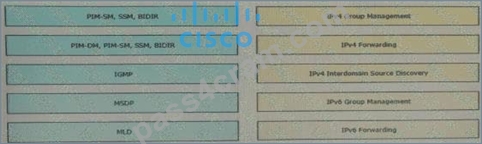
Answer:
Explanation: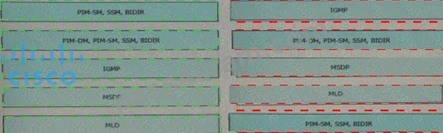
Explanation:
A picture containing table Description automatically generated
IPv4:
Host Registration - IGMP
Router Registration - PIM-DM, PIM-SM, SSM, BIDIR
Inter-Domain Source Discovery - MSDP
IPv6:
Host Registration - MLD
Router Registration - PIM-SM, SSM, BIDIR
NEW QUESTION # 157
You want to mitigate failures that are caused by STP loops that occur before UDLD detects the failure or that are caused by a device that is no longer sending BPDUs. Which mechanism do you use along with UDLD?
- A. Root guard
- B. BPDU guard
- C. BPDU filtering
- D. Loop guard
Answer: D
Explanation:
Loop Guardis designed to protect againstSTP loop conditionsthat may occur whenBPDUs are unexpectedly missingon a point-to-point link. This is especially relevant in cases where UDLD (Unidirectional Link Detection) might not detect the problem quickly enough. When BPDUs are absent, a switch might erroneously assume that the link is safe to forward, potentially leading to atemporary Layer 2 loop.
UsingLoop Guardensures that a port moves into aloop-inconsistentstate instead of forwarding traffic if BPDUs are missing, effectively stopping a loop before it forms. This makes it acomplementary mechanism to UDLD, which focuses on detecting unidirectional links at the physical layer, not STP control plane failures.
This recommendation aligns with CCDE v3.1 best practices forresilient Layer 2 designs, which emphasize using multiple mechanisms in tandem to proactively prevent failure conditions before traffic is impacted.
Why other options are incorrect:
* A. Root Guard: Prevents an unauthorized switch from becoming the root bridge but doesn't protect against missing BPDUs.
* B. BPDU Guard: Used mainly on access ports to prevent BPDU reception; not intended for core loop prevention.
* D. BPDU Filtering: Suppresses BPDU exchange entirely, which increases loop risk and is not suited for loop mitigation.
NEW QUESTION # 158
Refer to the exhibit.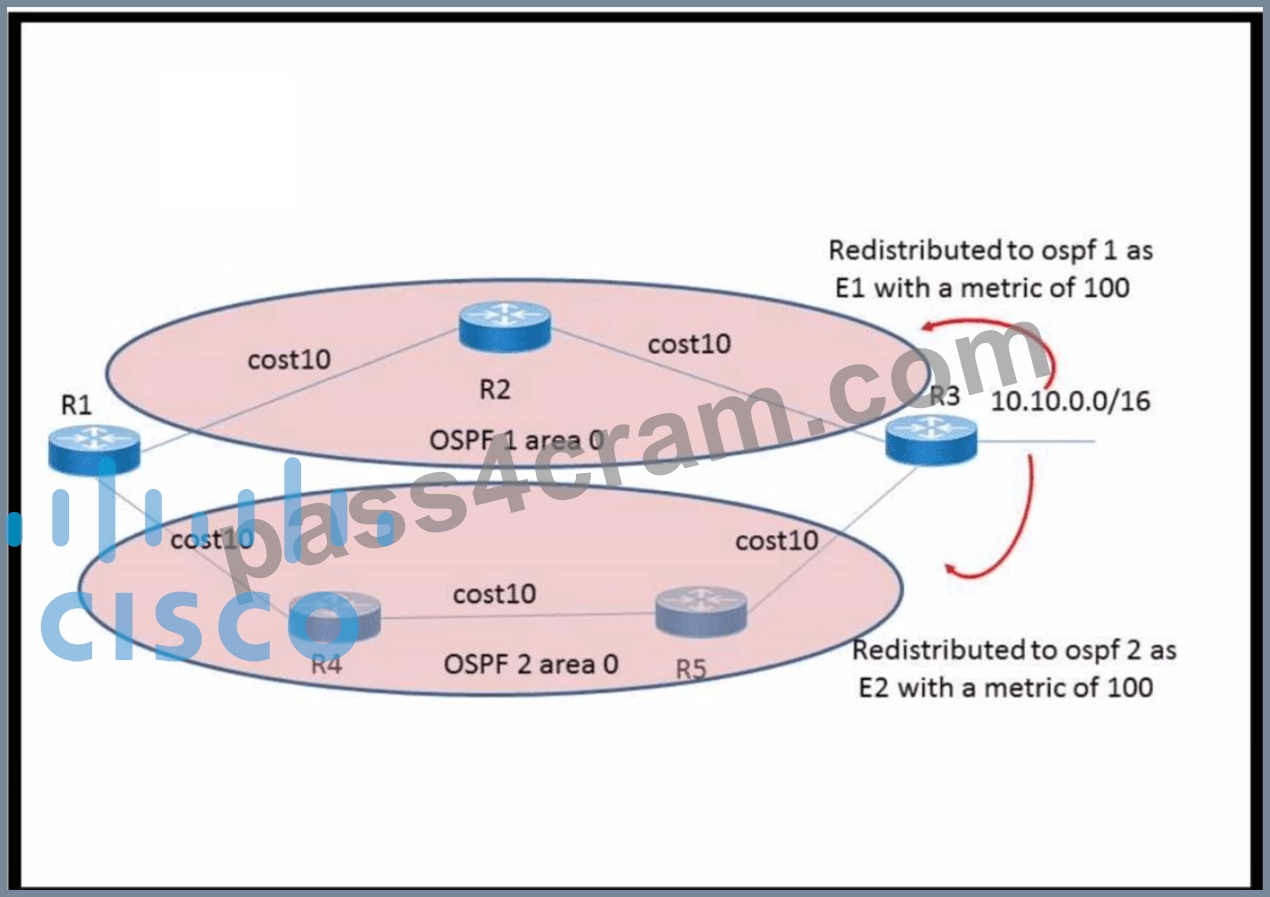
The network 10.10.0.0/16 has been redistributed to OSPF processes and the best path to the destination from R1 has been chosen as R1-R2-R3. A failure occurred on the link between R2 and R3 and the path was changed to R1-R4-R5-R3. What happens when the link between R2 and R3 is restored?
- A. The path reverts to R1-R2-R3 because this was the previous best path
- B. The path R1-R4-R5-R3 continues to be the best path because OSPF does not compare the metrics between two domains
- C. The path reverts back to R1-R2-R3 because the route type is E1
- D. The path R1-R4-R5-R3 continues to be the best path because the metric is better
Answer: C
Explanation:
In the topology shown, the 10.10.0.0/16 network is redistributed into two different OSPF processes-OSPF 1 and OSPF 2-from router R3. The redistribution uses the external route types:
* Into OSPF 1 as an E1 route with a metric of 100
* Into OSPF 2 as an E2 route with a metric of 100
When redistribution occurs in OSPF, two types of external routes can be injected:
* Type E1: Adds the internal OSPF cost to the external cost (total path cost = external metric + internal OSPF path)
* Type E2: Considers only the external cost and ignores internal path cost (default behavior) In this case:
* The path via R2-R3 (E1) includes both the external cost and the internal cost from R1 to R2 to R3. That is: 10 (R1-R2) + 10 (R2-R3) + 100 (external) = 120.
* The path via R4-R5-R3 (E2) will show a constant metric of 100 regardless of the internal OSPF path (10 + 10 = ignored).
So when the link between R2 and R3 fails, the path R1-R4-R5-R3 (E2 route with constant metric 100) becomes the preferred route.
However, when the link between R2 and R3 is restored, the E1 route will be recalculated as:
* Internal cost (R1-R2-R3) = 10 + 10 = 20
* External metric = 100
* Total = 120
OSPF always prefers E1 routes over E2 routes when both are available, even if the E2 route appears to have a better metric. This is because E1 routes provide more accurate end-to-end cost calculation.
Therefore, upon restoration, the routing table reverts to the E1 route via R1-R2-R3.
This behavior is aligned with OSPF protocol standards and is emphasized in CCDE v3.1 under the "Protocol Design Implications" domain, which focuses on redistribution behaviors, route-type preferences, and convergence consistency in multi-domain IGP designs.
NEW QUESTION # 159
As network designer, which option is your main concern with regards to virtualizing multiple network zones into a single hardware device?
- A. CPU resource allocation
- B. Bandwidth allocation
- C. Security
- D. Congestion control
- E. Fate sharing
Answer: E
Explanation:
When multiple virtualized network zones (such as VRFs, virtual firewalls, or logical partitions) are consolidated onto a single physical device, the primary concern is:
* A (Fate sharing): A single hardware failure, software crash, or resource exhaustion event could simultaneously impact all virtualized zones, creating a shared risk across multiple otherwise isolated services.
Other options explained:
* B: CPU resource allocation can be controlled via resource management but is not the primary risk.
* C: Congestion control is typically a traffic engineering issue, not a virtualization risk.
* D: Security isolation can be maintained through proper virtualization boundaries.
* E: Bandwidth can be managed through QoS and resource allocation.
-
NEW QUESTION # 160
Company XYZ is migrating their existing network to IPv6. Some access layer switches do not support IPv6, while core and distribution switches fully support unicast and multicast routing. The company wants to minimize cost of the migration. Which migration strategy should be used?
- A. Upgrade the non-supporting switches. Otherwise, it will cause an issue with the migration.
- B. Layer 2 switches will not affect the implementation of IPv6. They can be included in the design in their current state.
- C. The access layer switches must support IGMP snooping at a minimum. Any switches that do not support IGMP snooping must be replaced.
- D. The access layer switches must support DHCPv6. Any switches that do not support DHCPv6 must be replaced.
Answer: B
Explanation:
* C (Layer 2 switches unaffected):IPv6 operates at Layer 3, so pure Layer 2 switches forward frames without needing IPv6 awareness. As long as switches can transparently forward Ethernet frames, IPv6 functionality will be preserved, minimizing unnecessary hardware upgrades.
Other options explained:
* A/B/D: These unnecessarily increase cost and complexity for basic Layer 2 functionality where IPv6 awareness is not mandatory.
NEW QUESTION # 161
The CIA triad is foundational to information security, and one can be certain that one or more of the principles within the CIA triad has been violated when data is leaked or a system is attacked Drag and drop the countermeasures on the left to the appropriate principle section on the right in any order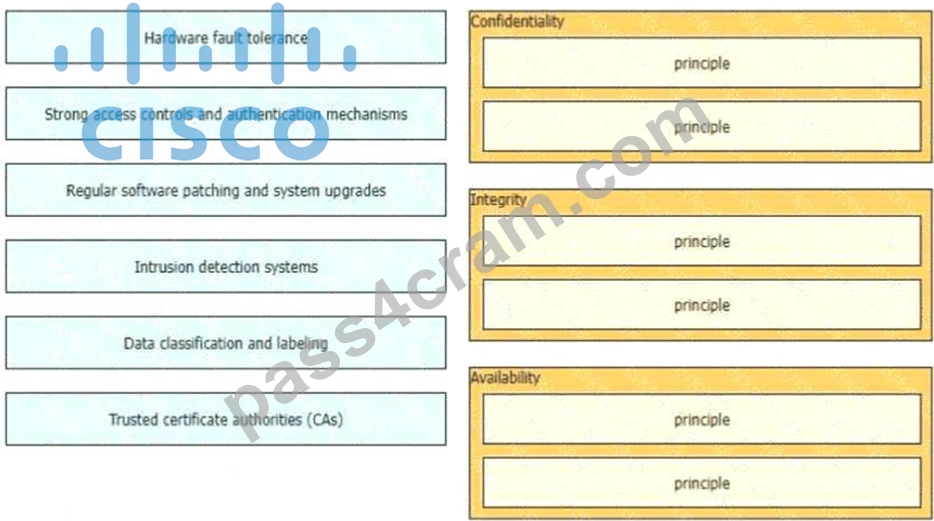
Answer:
Explanation: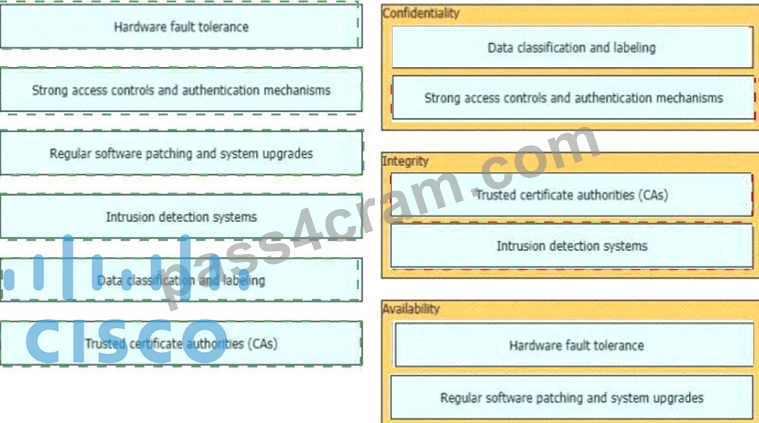
Explanation: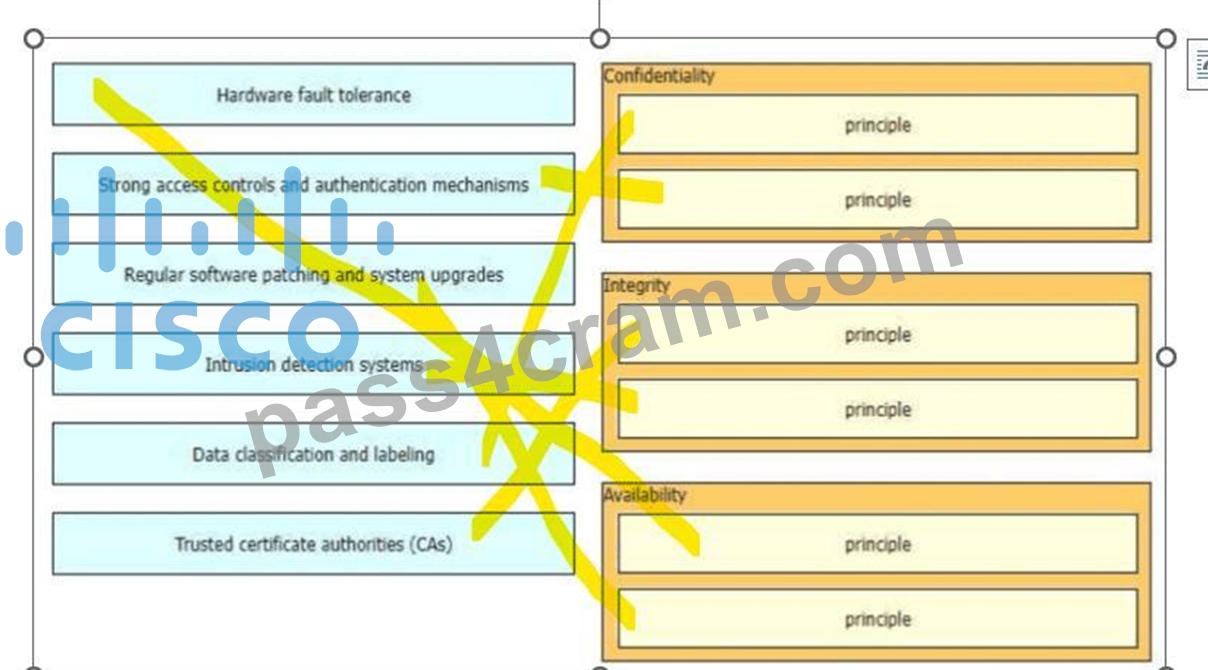
NEW QUESTION # 162
[Security, Automation, and Policy Integration in Design] To protect against future perimeter breaches, which two design options can help? (Choose two)
- A. Virtualization
- B. Microperimeters
- C. Microzoning
- D. Segmentation
- E. Domain fencing
Answer: B,D
Explanation:
#Explanation:
* B: Segmentation isolates network zones (e.g., separating finance from guest access), limiting lateral movement after a breach.
* E: Microperimeters apply security controls closer to the application or workload, providing granular control and defense in depth.
Other options:
* A: Microzoning is not a widely defined or standard practice in network security.
* C: Domain fencing is not a standard security term or methodology.
* D: Virtualization is a technology, not a security architecture.
NEW QUESTION # 163
......
400-007 Exam with Accurate Cisco Certified Design Expert (CCDE) Written Exam PDF Questions: https://tesking.pass4cram.com/400-007-dumps-torrent.html