


(2026) PASS NS0-593 exam with Network Appliance NS0-593 Real Exam Questions
Real exam questions are provided for NetApp NCSE tests, which can make sure you 100% pass
The NS0-593 certification exam is a valuable credential for IT professionals who are seeking to advance their careers in the field of storage and data management. With the increasing demand for skilled storage administrators and support engineers, this certification can help individuals stand out from the competition and demonstrate their expertise in supporting NetApp storage solutions.
NEW QUESTION # 21
You receive the panic message shown in the exhibit.
In this scenario, which component should you troubleshoot first?
- A. the memory module in slot 1
- B. the PCI card in slot 3
- C. the MetroCluster FC-Vl card in slot 6
- D. the CPU
Answer: B
Explanation:
= The panic message indicates that the node encountered a fatal error while accessing the PCI card in slot 31. This could be due to a hardware failure, a firmware issue, or a driver problem. The first component to troubleshoot is the PCI card in slot 3, as it is the most likely source of the error. You can use the system node hardware pci show command to check the status of the PCI card and the system node hardware firmware update command to update the firmware if needed2. You can also use the Panic Message Analyzer tool from the NetApp Support Site to determine whether your panic was caused by a known software issue3. Reference = 1: REBOOT (panic) ALERT - AutoSupport message 2: [system node hardware pci show] 3: [Panic Message Analyzer tool]
NEW QUESTION # 22
A 2-node cluster hosts only NAS data UFs. Allnodes lose access to the cluster network.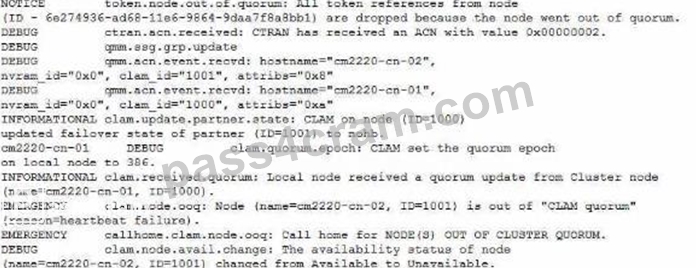
Referring to the exhibit, which statement is correct?
- A. No takeover event will occur and NAS data UFs will not be accessible.
- B. Both nodes race to takeover the other, one node will takeover the other node.
- C. NAS data UFs are accessible on only the node that has Epsilon.
- D. All nodes in the cluster reset and NAS data UFs are not accessible after reboot.
Answer: D
NEW QUESTION # 23
A customer reports that some of their client computers are unable to access a FlexGroup over CIFS. This
problem involves only their older Windows XP clients and some printers and scanners.
In this scenario, which statement Is correct?
- A. FlexGroup requires CIFS shares to use the Continuously Available Feature, which these clients do not
support. - B. These systems use Offloaded Data Transfer, which is an unsupported feature in FlexGroup.
- C. FlexGroup requires CIFS shares to be located in qtrees, which these clients do not support.
- D. These systems use the SMQI protocol which Is an unsupported feature in FlexGroup
Answer: A
NEW QUESTION # 24
A customer enabled NFSv4.0 on an SVM and changed the client mount from NFSv3 to NFSv4. Afterwards, the customer found that the directory owner was changed from root to nobody.
In this scenario, which statement is true?
- A. The export policy is not configured properly.
- B. The customer did not configure name services on the SVM.
- C. The clients must be restarted to start using NFSv4.
- D. The ID mapping domains do not match between the client and server.
Answer: D
Explanation:
NFSv4 is a network file system protocol that supports security, performance, and scalability features. NFSv4 uses ID mapping to ensure that the permissions of files and directories are consistent across different NFSv4 servers and clients1 ID mapping is the process of translating the user and group identifiers (UIDs and GIDs) of the local system to the user and group names (user@domain and group@domain) of the remote system, and vice versa. ID mapping is done by the idmapd service, which uses the /etc/idmapd.conf file to determine the domain name of the system2 ID mapping requires that the NFSv4 server and client have the same domain name configured in the /etc/idmapd.conf file. If the domain names do not match, the idmapd service cannot map the UIDs and GIDs to the user and group names, and the permissions of the files and directories will be shown as nobody:nobody, which is the default anonymous user3 Therefore, if a customer enabled NFSv4.0 on an SVM and changed the client mount from NFSv3 to NFSv4, and found that the directory owner was changed from root to nobody, the most likely cause is that the ID mapping domains do not match between the client and server. The customer should check and correct the /etc/idmapd.conf file on both systems, and restart the idmapd service and remount the NFSv4 share4 Reference:
1: ONTAP 9 - Network File System (NFS) - The Open Group 2: ONTAP 9 - NFSv4 and NFSv4.1 Enhancements - The Open Group 3: NFSv4 mount incorrectly shows all files with ownership as nobody:nobody - Red Hat Customer Portal 4: NFSv4 mountpoint shows incorrect ownerships as nobody:nobody in CentOS/RHEL - The Geek Diary
NEW QUESTION # 25
Your customer mentions that they have accidentally destroyed both root aggregates in their two-node cluster.
In this scenario, what are two actions that must be performed? (Choose two.)
- A. Re-create the cluster from the local backup.
- B. Install ONTAP from a USB device.
- C. Re-create the cluster from the remote backup.
- D. Rejoin the second node to the re-created cluster.
Answer: B,D
Explanation:
If both root aggregates are destroyed in a two-node cluster, the cluster will be inoperable and the data will be inaccessible. To recover from this situation, you need to perform the following actions:
Install ONTAP from a USB device on one of the nodes. This will create a new root aggregate and a new cluster on that node.
Rejoin the second node to the re-created cluster. This will also create a new root aggregate on the second node and synchronize it with the first node.
Restore the cluster configuration and data from a backup, if available. Reference = ONTAP 9 Documentation Center Storage System Recovery Troubleshooting Recovering from a root aggregate failure
NEW QUESTION # 26
You have a new VMware vSphere cluster with ESXI 7.0U2 hosts. The hosts are connected to a 4-node AFF
A400 NetApp ONTAP9.8 cluster with FC LUNs. You have a requirement to identify and follow I/Os from
each VM on the shared FC LUN-backed datastores for troubleshooting purposes.
In this scenario, which VMware feature Is supported by ONTAP software to accomplish this task?
- A. Storage I/O Control (SIOC)
- B. Network I/O Control (NIOC)
- C. Virtual machine ID (VMID)
- D. vSphere Cluster Services (vCLS)
Answer: D
NEW QUESTION # 27
You recently discovered the error message shown below in your ONTAP logs.
What should be your first action to correct this Issue?
- A. Determine the root cause behind the inconsistency before attempting any recovery procedure.
- B. Use the storage takeover command on the storage controller that contains my_data_vol.
- C. Power cycle all the disk storage shelves that contain drives of the aggregate with the my_data_vol
volume. - D. Use the wafliron command against my_data_vol to solve the inconsistency on the volume.
Answer: C
NEW QUESTION # 28
Which two throughput elements are controlled by host applications? (Choose two.)
- A. concurrency
- B. Jitter
- C. operation size
- D. latency
Answer: B,D
NEW QUESTION # 29
Which two statements about NetApp Cloud Volumes ONTAP licenses ate true? (Choose two.)
- A. AWS Marketplace contracts cannot be mixed with BYOL.
- B. BYOL licenses are purchased directly from NetApp.
- C. Capacity-based license packages support only single-node configurations.
- D. Having an Essentials package enables you to convert to another licensing option.
Answer: B,D
Explanation:
Having an Essentials package enables you to convert to another licensing option. This is true because the Essentials package is a capacity-based licensing option that allows you to pay for Cloud Volumes ONTAP per TiB of capacity. You can switch to another capacity-based package or to a Keystone Flex Subscription at any time1.
BYOL licenses are purchased directly from NetApp. This is true because BYOL stands for Bring Your Own License, which means you need to obtain a license from NetApp before deploying Cloud Volumes ONTAP systems in any cloud provider2.
Capacity-based license packages support only single-node configurations. This is false because capacity-based license packages support both single-node and HA configurations1.
AWS Marketplace contracts cannot be mixed with BYOL. This is false because you can mix AWS Marketplace contracts with BYOL as long as the license type matches the instance type3. Reference: 1: Cloud Volumes ONTAP licensing | NetApp Documentation 2: Set up licensing for Cloud Volumes ONTAP in Google Cloud - NetApp 3: Set up licensing for Cloud Volumes ONTAP in AWS - NetApp
NEW QUESTION # 30
A user mentions that their home drive, that Is an export within a volume, is no longer allowing them to save
files. The drive reports that it Is full, even though It shows that minimal data is written to it.
Which statement would explain this behavior?
- A. Other users wrote to this user's home drive.
- B. Other files within the volume are also owned by the user, exceeding the user quota.
- C. The mount is stale and uses a cached version of the volume.
- D. The client system needs to remount the export to show the proper space.
Answer: B
NEW QUESTION # 31
You are troubleshooting a CIFS connection issue that is reported by some users. You decide to collect a packet trace.
In this scenario, after you generate the packet trace, where do you find the trace file?
- A. /etc/log/mlog/packet._traces Of all nodes
- B. /vol0/paclcet_traces of the CIFS SVM
- C. /packet_traces of the node hosting the LIF
- D. /etc/log/packet_traces of the node hosting the LIF
Answer: D
Explanation:
According to the NetApp Knowledge Base, packet traces are stored in the /etc/log/packet_traces directory of the node hosting the LIF. This applies to ONTAP 9.10 and above systems. For ONTAP 9.2 to 9.9 systems, the procedure to capture packet traces is similar, but the command syntax is slightly different. For ONTAP pre-9.2 systems, the procedure is different and requires the use of the tcpdump command. Reference = How to capture packet traces on ONTAP 9.10+ systems, How to capture packet traces (tcpdump) on ONTAP 9.2 to 9.9 systems, How to capture packet traces in ONTAP pre-9.2
NEW QUESTION # 32
A system panic due to an "L2 watchdog timeout hard reset" error occurred. You have found a FIFO message
in the SP log.
Which FIFO message Is useful for Investigating this Issue?
- A. ONTAP Shutdown BBSP:C=00 L=2F FIFO:
- B. before Reset BBSP:C=00 L=00 FIFO:
- C. BIOS exit BBSP:C=2F L=20 FIFO: 2 C8 C9 C4 24 4 6 18 7 8 11
- D. before NMI BBSP:C=00 L=00 FIFO: F3 F2 F1 F0 5 B2 0 0 0 80 20 E F E3 C0 C2 3 4 6 7 9 9 A
Answer: C
NEW QUESTION # 33
When an administrator tries to create a share for an existing volume named voll, the process fails with an error.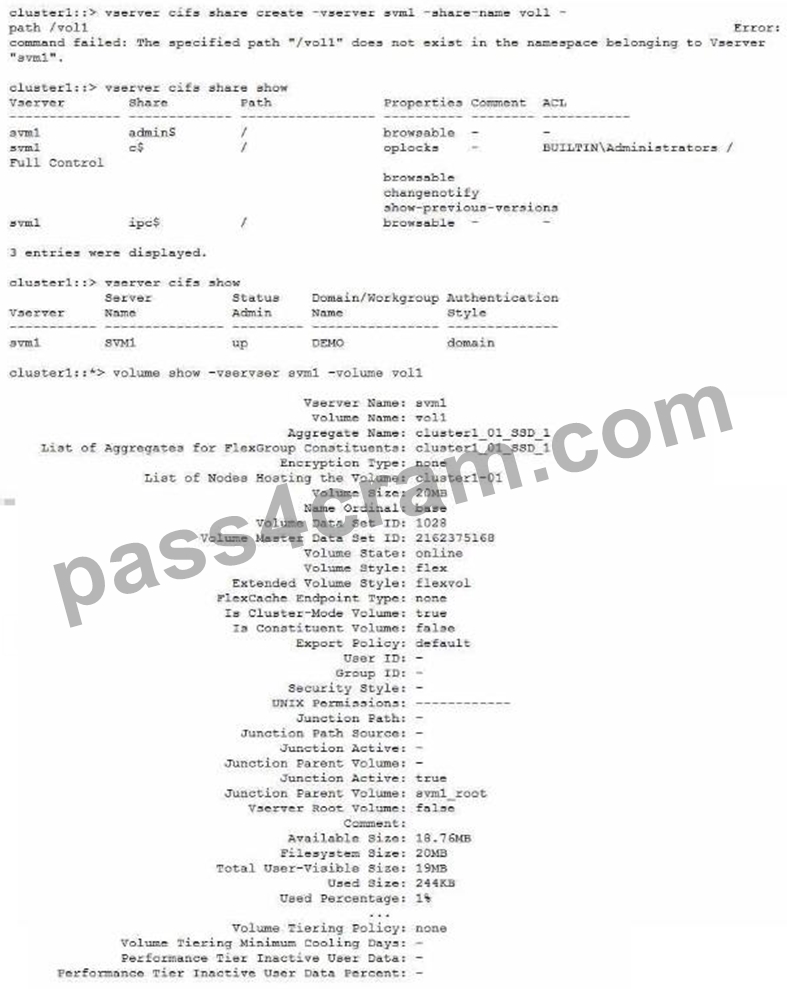
Referring to the exhibit, what Is the reason for the error?
- A. The volume must have a type of DP.
- B. The volume has not been mounted.
- C. The CIFS service is not in workgroup mode.
- D. The CIFS service is not authenticating properly with the domain controller.
Answer: B
Explanation:
The error message indicates that the specified path "/vol1" does not exist in the namespace belonging to Vserver "svm1". This means that the volume "vol1" has not been mounted to the Vserver's namespace, which is required for creating a share. The volume type, the CIFS service status, and the CIFS service mode are not relevant to the error. Reference = https://www.netapp.com/support-and-training/netapp-learning-services/certifications/support-engineer/
https://mysupport.netapp.com/site/docs-and-kb
NEW QUESTION # 34
A 2-node cluster hosts only NAS data UFs. All nodes lose access to the cluster network.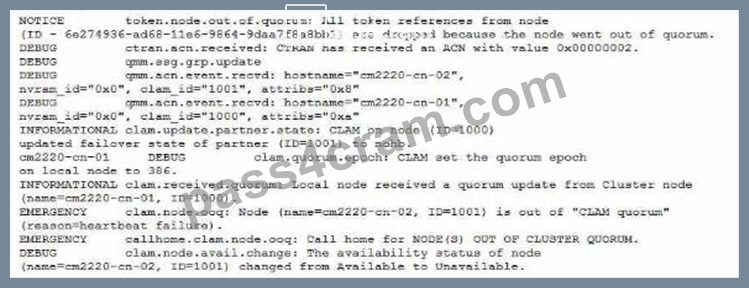
Referring to the exhibit, which statement is correct?
- A. All nodes in the cluster reset and NAS data UFs are not accessible after reboot.
- B. NAS data UFs are accessible on only the node that has Epsilon.
- C. No takeover event will occur and NAS data UFs will not be accessible.
- D. Both nodes race to takeover the other, one node will takeover the other node.
Answer: B
Explanation:
The two throughput elements that are controlled by host applications are operation size and concurrency. Operation size refers to the amount of data that is transferred in a single I/O request, and concurrency refers to the number of I/O requests that are issued simultaneously. Both of these factors affect the throughput of a host application, as they determine how much data can be sent or received within a given time period. Larger operation sizes and higher concurrency can increase the throughput, but they may also increase the latency and resource consumption12. Reference: 1: NetApp Performance Analysis on Data ONTAP - Chapter 3: Host-Side Performance 2: NetApp Performance Analysis on Data ONTAP - Chapter 4: Storage System Performance
NEW QUESTION # 35
Your customer calls you because one application is not able to access a NetApp ONTAP S3 bucket. While reviewing the EMS log on the cluster, you see the following message:
The same credentials work in another application.
In this scenario, what would cause this problem?
- A. The application is trying to log in as an anonymous user.
- B. The application is using v4 signatures.
- C. The application is using v2 signatures.
- D. The application is trying to access using the HTTP protocol.
Answer: C
Explanation:
The error message indicates that the access is denied for user 'anonymous user' (Vserver 50), from client IP 10.10.10.10 accessing resource '/offload-target'. This means that the application is not providing a valid user name or access key to authenticate with the ONTAP S3 server. According to the NetApp documentation1, ONTAP S3 server supports both v2 and v4 signatures, but v2 signatures are deprecated and not recommended. Therefore, the application should use v4 signatures to access the ONTAP S3 bucket. Additionally, the application should specify the bucket name in the host name, not in the resource path, as shown in the following example2:
https://bucket-name.s3-server-name.com/object-name
Reference = 1 ONTAP S3 Server Overview - NetApp Documentation 2 Accessing an ONTAP S3 bucket - NetApp Documentation
NEW QUESTION # 36
A system panic due to an "L2 watchdog timeout hard reset" error occurred. You have found a FIFO message in the SP log.
Which FIFO message Is useful for Investigating this Issue?
- A. ONTAP Shutdown BBSP:C=00 L=2F FIFO:
- B. before Reset BBSP:C=00 L=00 FIFO:
- C. before NMI BBSP:C=00 L=00 FIFO: F3 F2 F1 F0 5 B2 0 0 0 80 20 E F E3 C0 C2 3 4 6 7 9 9 A
- D. BIOS exit BBSP:C=2F L=20 FIFO: 2 C8 C9 C4 24 4 6 18 7 8 11
Answer: C
Explanation:
= The FIFO message before NMI is useful for investigating the issue because it shows the state of the system before the non-maskable interrupt (NMI) was triggered by the L2 watchdog timeout. The FIFO message contains information about the CPU registers, the stack pointer, the instruction pointer, and the last executed instructions. This can help identify the cause of the system hang or deadlock that led to the watchdog reset. The other FIFO messages are not useful because they show the state of the system after the reset or shutdown, which may not reflect the original problem. Reference = https://kb.netapp.com/onprem/ontap/hardware/Handling_L2_Watchdog_Resets_on_the_FAS8200_and_AFF_A300_platforms
https://docs.netapp.com/us-en/ontap-metrocluster/install-ip/task_sw_config_restore_defaults.html
NEW QUESTION # 37
You have a 4-node NetApp ONTAP 9.8 cluster with an AFF A400 HA pair and a FAS8300 HA pair with 16
TB NL-SAS drives. You are asked to automatically tier 150 TB of Snapshot copy data from the AFF A400
aggregates to the FAS8300.
In this scenario, which ONTAP license must be added to the cluster to accomplish this task?
- A. VE license
- B. TPM license
- C. S3 license
- D. FabricPool license
Answer: B
NEW QUESTION # 38
Your customer installed the shelf firmware for their NS224 shelf over a week ago, and the firmware has not upgraded on shelf 1 module B. The customer wants to know what the next steps would be to get the firmware upgraded after verifying that the shelf firmware is indeed loaded onto the system.
Which step would you perform to complete the firmware upgrade?
- A. Power cycle the shelf.
- B. Reseat the disk in Bay 0.
- C. Reseat the NSM100 module.
- D. Reseat the PSU of the shelf.
Answer: C
Explanation:
The question refers to a scenario where the shelf firmware for an NS224 shelf has not been upgraded on one of the NVMe shelf modules (NSM) after a week of installation.
The NSM is responsible for managing the communication between the drives and the I/O modules (IOM) in the shelf1.
The shelf firmware for the NSM is automatically updated when the NSM is inserted into the shelf or when the system is rebooted2.
If the automatic update does not work, the manual update process involves reseating the NSM, which means removing it from the shelf and inserting it back3.
Reseating the NSM triggers the firmware update and also resets the NSM's state3.
The other options are not correct, because:
B) Reseating the disk in Bay 0 will not affect the NSM firmware update, as the disk is not connected to the NSM1.
C) Power cycling the shelf will disrupt the I/O operations and may cause data loss or corruption4.
D) Reseating the PSU of the shelf will not affect the NSM firmware update, as the PSU is not connected to the NSM1. Reference:
NS224 NVMe drive shelf overview - NetApp
Shelf firmware update process - NetApp
Module firmware upgrade stuck on NS224 shelf - NetApp Knowledge Base
Power cycle a disk shelf - NetApp
NEW QUESTION # 39
You receive the "Unable to connect to the management gateway server"error when trying to connect to a node
management IP.
In this situation, how do you determine whether core dumps are generated for the mgwd user space process?
- A. Log in to the clustershell using the node console and collect the core dumps from the clustershell.
- B. Log in to the nodeshell using the node console and collect the core dumps from the nodeshell.
- C. Log in to the systemshell and collect core dumps from thesystemshell.
- D. Log in to the service processor and collect the core dumps from the service processor.
Answer: D
NEW QUESTION # 40
Your customer has mounted an NFS SVM from a Linux client unci performance is very poor. The customer is
certain that they have jumbo frames enabled. They have verified an MTU of 9000 on both the Linux client and
the broadcast domain on the NetApp ONTAP 9.8 cluster.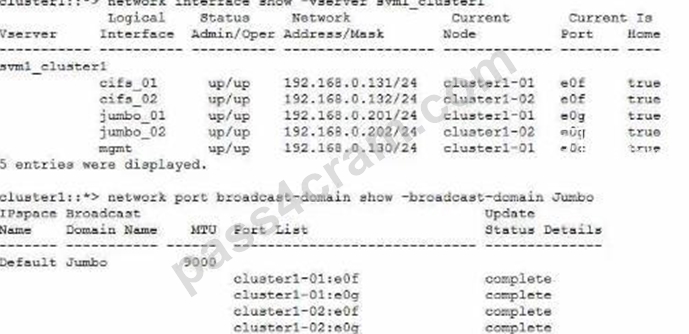
Referring to the exhibit, which ONTAP command will help isolate a possible MTU mismatch?
- A.

- B.

- C.

- D.

Answer: D
NEW QUESTION # 41
After a motherboard replacement on a NetApp AFF A300 in a SAN environment, the customer states that ports 0e and 0f are unable to connect to the fabric. The ports report "offline".
What would you examine first to troubleshoot the issue?
- A. system node hardware unified-connect show command output
- B. storage port show command output
- C. vserver fcp interface show command output
- D. vserver fcp wwpn-alias show command output
Answer: A
Explanation:
Here is my reasoning:
The system node hardware unified-connect show command displays the status and configuration of the Unified Connect ports on a node1. This command can help you identify if the ports are configured correctly and if they have any errors or faults.
The ports 0e and 0f on the AFF A300 are 10GbE ports that support both Ethernet and Fibre Channel over Ethernet (FCoE) protocols2. These ports are part of the Unified Connect feature, which enables you to use the same physical port for different protocols without requiring additional hardware3.
If the ports are offline, it could indicate a problem with the port configuration, the cable connection, the switch configuration, or the protocol settings. The system node hardware unified-connect show command can help you troubleshoot these issues by showing you the port mode, speed, duplex, state, and error count1.
The other commands in the options are not as helpful for troubleshooting the port issue, because they show different information that is not related to the Unified Connect feature or the port status. For example:
The vserver fcp wwpn-alias show command displays the World Wide Port Name (WWPN) aliases for the Fibre Channel Protocol (FCP) logical interfaces (LIFs) on a Vserver4. This command can help you manage the FCP LIFs, but it does not show the status of the physical ports or the Unified Connect feature.
The storage port show command displays the status and configuration of the storage ports on a node5. This command can help you manage the storage ports, but it does not show the status of the Unified Connect ports or the FCoE protocol.
The vserver fcp interface show command displays the status and configuration of the FCP LIFs on a Vserver6. This command can help you manage the FCP LIFs, but it does not show the status of the physical ports or the Unified Connect feature.
Here are some references that might help you:
1: system node hardware unified-connect show - NetApp 2: AFF A300 system installation - NetApp 3: Unified Connect - NetApp 4: vserver fcp wwpn-alias show - NetApp 5: storage port show - NetApp 6: vserver fcp interface show - NetApp
NEW QUESTION # 42
You want to assign storage access to an NVMe protocol host.
Which three objects must be configured to accomplish this task? (Choose three.)
- A. the NVMe namespace
- B. an NVMe LUN
- C. an NVMe LIF
- D. the NVMe broadcast domain
- E. the NVMe subsystem
Answer: A,C,E
Explanation:
To assign storage access to an NVMe protocol host, you need to configure the following objects:
The NVMe subsystem, which is a logical entity that represents a group of NVMe namespaces that can be accessed by one or more hosts1.
An NVMe LIF, which is a logical interface that provides network connectivity for the NVMe subsystem2.
The NVMe namespace, which is a logical volume that is exposed to the host as an NVMe device1.
You do not need to configure the NVMe broadcast domain or the NVMe LUN, as these are not relevant for NVMe protocol host access. Reference = 1: Configuring NVMe-oF - Hitachi Vantara Knowledge 2: Basic VMware NVMe Architecture and Components
NEW QUESTION # 43
A storage administrator reports that a monitoring toot is reporting that the storage controller reads between 90% to 93% CPU use. You run the sysstat -m command against the node in question.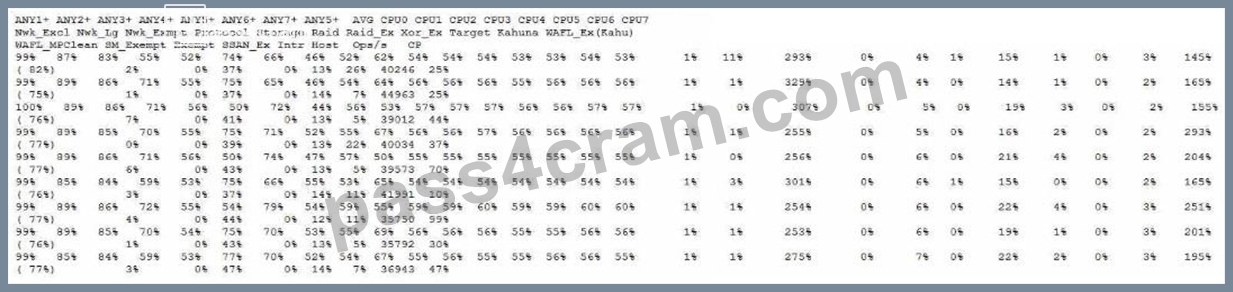
Referring to the exhibit, which statement is correct?
- A. High network exempt use could be a problem.
- B. The customer should be advised to exclude certain workflows to reduce use.
- C. The CPU Is not a first-order monitoring metric for ONTAP.
- D. You should immediately investigate further by gathering perfstat data and opening a support case.
Answer: C
Explanation:
= CPU utilization in ONTAP is not a linear measure of the system load, nor can it be used alone as a measure of the overall system utilization. ONTAP uses a Coarse Symmetric Multiprocessing (CSMP) design which partitions system functions into logical processing domains, each with its own scheduling rules and resource availability. Therefore, a high CPU utilization does not necessarily indicate a performance problem, unless it is accompanied by other contributing factors such as high latency, low throughput, or high queue depth. ONTAP has several mechanisms to optimize CPU usage and balance the workload across the cores, such as WAFL parallelization, exempt processing, and CPU pinning. The CPU utilization reported by the sysstat command is an average across all cores and domains, and does not reflect the actual CPU activity or availability for each domain. Therefore, the CPU is not a first-order monitoring metric for ONTAP, and other metrics such as latency, throughput, and queue depth should be considered first. Reference = What is CPU utilization in Data ONTAP: Scheduling and Monitoring?, How to measure CPU utilization, What are CPU as a compute resource and the CPU domains in ONTAP 9?, Monitoring CPU utilization before ONTAP upgrade
NEW QUESTION # 44
......
Network Appliance NS0-593 certification exam is designed for professionals who want to demonstrate their skills and knowledge in supporting and troubleshooting NetApp ONTAP storage systems. NetApp Certified Support Engineer ONTAP Specialist certification is ideal for those who work in IT support roles and have experience working with NetApp storage solutions. NS0-593 exam covers topics such as installation, configuration, and troubleshooting of NetApp storage systems, as well as data protection, performance optimization, and storage efficiency.
Latest NS0-593 Pass Guaranteed Exam Dumps Certification Sample Questions: https://tesking.pass4cram.com/NS0-593-dumps-torrent.html